
Presentations
Keynote Presentations
- Professor Tim Benton. Implications of a volatile world for UK food systems and security.
- Prof Dame Theresa Marteau, Honorary Fellow, Christ’s College, and Associate Fellow, Centre for Science and Policy, University of Cambridge. Changing Behaviour Across Populations and Politicians
- Dan Saladino, Author (‘Eating to Extinction’) and Broadcaster (‘The Food Programme’, BBC Radio 4)
Plenary talks from TUKFS
- Dr Albert Muleke, Cain M, Chapman P J, Wade R N, Smith K E, Burgess P J, Pexas G, Wiltshire C K, Harrison M T, Christie-Whitehead K M, de Voil P G, Liu K, Chapagain R (Fix Our Food). Transforming UK agriculture: modelling the impact of regenerative farming in Yorkshire under a changing climate.
- Fleur ter Ellen, Parsons K, White M, Sawyer A (Mandala). Unpacking the development and implementation of the Birmingham Food System Strategy: a Ripple Effects Mapping study.
- Naomi Fallon, Yap C, Vogel C (TUKFS Centre for Doctoral Training, Centre for Food Policy, City St Georges, University of London). How does power shape UK free school meals policy? A critical discourse analysis of parliamentary debates 2015-2025 [slides not available for sharing]
- Dr Sophie Hedges, Yau A, Parsons K, Sawyer A, White M, Cummins S (Mandala, LSHTM). Mapping the physical and digital food environment in Birmingham: A cross-sectional analysis of online food delivery platforms and point-of-interest data.
Parallel sessions
Symposia
- Symposium 1.1: Expanding free school meal provision in England: economic evidence, auto-enrolment, and implementation for scalable, equitable policy reform
- Paper 1: Using cost-benefit analysis to estimate the economic value of a complex intervention: expanding provision of primary school meals in England. Bisola , Kesaite V, Yau A, Pokhilenko I, Loopstra R, Cummins S, White M, Frew E
- Paper 2: Auto-enrolment of Free School Meals. Maria Bryant, Mahdi S, Padgett L, Oxley R, Bremner M, Goudie S, Doherty B
- Paper 3: Policy options to increase the provision of Free School Meals (FSMs) in England: a qualitative exploration of policy implementation challenges through stakeholder. Emma Frew, Jones CP, Osifowora B, Kesaite V, Pokhilenko I, Cummins S, Loopstra R, Sawyer A, Yau A, White M
- Symposium 1.2: Enhancing TUKFS programme level impact via three collaborative ‘Synergy Projects’: a critical discussion of process and outcome
- Paper 1: Interdisciplinary working in food systems research: lessons from the TUKFS programme. Peter Jackson, Kelly Parsons, Wells R, Fletcher I, Lemos D
- Paper 2: Bridging theory and practice for actionable change in transforming food systems (BRIDGE-ACT). Marta Lonnie, Hunter E, Didcock H, Puranik M, Norton V, Gardiner B, Bosseaux J, Edwards F, Mogeni B, Greatwood H, Johnstone A
- Paper 3: TUKFS ‘co-production toolkit’ – maximising its reach beyond academics, to project beneficiaries and policymakers. Clare Pettinger, Hardman C, Wells R, Ehgartner U, Morgans L, Boyle N, Shaw N, Howard L, Mumby H
- Symposium 1.3: From research to impact: using real-world supermarket transaction data to provide insights for policy and practice in the FIO and DIO food projects
- Paper 1: Learnings from working with industry partners – the Academic-Industry Partnership “AIP” framework. Victoria Jenneson, Stone, RA, Ennis E, Naisbitt R, Lomax N., Morris M
- Paper 2: The retailer perspective on implementing and evaluating interventions to support healthy sustainable food purchasing: challenges and opportunities. Charlotte Hardman, Stone RA, Brown A, Douglas F, Greatwood H, Griffiths C, Hunter E, Johnstone A, Lonnie M, Morris M, Skeggs H
- Paper 3: FIO Food: using supermarket transaction data to estimate environmental sustainability footprints of food and drink purchases, and their interplay with health, demographics and food and drink cost. Emma Wilkins, Green M, Gilthorpe MS, Johnstone A, Morris M
- Paper 4: DIO Food: using supermarket transaction data to evaluate the impact of the High in Fat, Sugar and Salt (HFSS) legislation on purchases of HFSS products and whether the legislation was equitable. Alice Kininmonth, Jenneson VL, Wilkins E, Chukwu I, Eselebor O, Pontin F, Naisbitt R, Johnstone A, Fildes A, Morris M
- Paper 5: From research to action: cross-collaboration learnings. Hannah Skeggs
- Symposium 1.4: Environmental and socio-economic impacts of transitioning to regenerative agriculture
- Paper 1: Measuring effects of stacking regenerative agriculture principles on environmental and socio-economic outcomes: Results from a drought year. Kellie Smith, Wade R, Gilpin M, Armitage H, Collins L, Doherty B, Chapman P
- Paper 2: The H3 Project: results of a four-year quasi-experiment measuring outcomes of regenerative agriculture transitions in England. Katherine Berthon, Jaworski CC, Beacham JD, Jackson P, Leake J, McHugh NM, Capstick L, Daniell T, Zhao Y, Watt PJ, Dicks LV
- Paper 3: Farmer perspectives on the transition to regenerative agriculture: barriers, opportunities and economic dimensions. Jonathan Beacham, Jackon P, Berthon K, Blenkinsopp A, Dicks L, Rogers K, Chapman P, Wade R
- Symposium 1.5: Drivers, impact, variation, and redistribution of food donations, surplus and waste: insights to balance conflicting aims in the UK food system
- Paper 1: Household spend on wasted food and environmental impact of food waste across household types: a cross-sectional analysis of data from an English consumer panel. Amy Yau, Hedges S, Ball T, Balmford A, Dicks LV, Adeosun P, Fu L, Kesaite V, Parsons K, Sawyer A, White M, Cummins S, on behalf of the Mandala Consortium [slides not available for sharing]
- Paper 2: The reliability of unsold fresh food as a source for redistribution: a case study by simulation comparing retail outlets by size and inventory level using data from British supermarkets. Owen Nicholas on behalf of the Mandala Consortium
- Paper 3: Managing fluctuations in UK fresh produce redistribution. Michael Bourlakis, Chadwick M, Hadley P, Sawyerr E, Doherty B, Wagstaff C
- Symposium 4.1: Methods to improve the sustainability and nutrition of school dinners for both planetary and population health
- Paper 1: Co-designed menu swaps to improve nutrition and environmental sustainability of primary school meals in socioeconomically deprived settings: early findings from the FixOurFood intervention. Zeynep Caferoglu Akin, Nixon N, Oxley R, Mahdi S, Bridle S, Kluczkovski A, Brunstrom J, Davison P, Harris N, Jemison A, Higginson P, Doherty B, Bryant M
- Paper 2: Acceptability of new school menus for population and planetary health: a proof-of-concept study. Sundus Mahdi, Caferoglu Akin Z, Nixon N, Padgett L, Doherty B, Bryant M
- Paper 3: Children’s acceptance and liking of novel UK-grown beans in primary schools: a quasi-experimental evaluation of the BeanMeals intervention. Charlotte A Hardman, Bayes N, Didier L, & Ingram J
Individual papers 2.1: Consumer data
- Leona Lindberg, Brereton P, Hutchinson G, Livingstone D Thomas EL, Cheng S, Grigoriadis V, Nugent AP, Woodside JV, Smyth B, Vlajic J, Fu R, Collins O, Areal F, Frewer LJ. The development and testing of the Sus-Health Index: a combined score which assesses and presents the nutritional content and environmental impact
- Amy Yau, Hedges S, Parsons K, Smith R, White M, Cummins S. Overlap between healthiness, environmental impact and cost: a cross-sectional analysis of food and drink purchases made by an English consumer panel [slides not available for sharing]
- Rod Wilson, Bateman I, Gadanakis Y, Ellis R, Perry A, Allen M, Smirnoff N, Buckling A, Sierocinski P, Blackwell M, Dunn R, Russell B, Tingley D, Campos-González J, Morello T, Sanders T, Guppy O, Manchi R. The sustainable UK king prawn project
- Michelle Thomas, Fisher D, Methven L, Wagstaff C. Grocery purchasing and dietary patterning amongst households in the UK across social-economic- classifications: secondary data analysis using WorldPanel by Numerator and National Diet and Nutrition Survey (NDNS) data sets
Individual papers 2.2: System transformation
- Fergus Lyon, Vickers I. Open innovation for transforming food systems: social enterprise as a catalyst for bottom-up collaborative social innovation
- Umar Muhammad, Manning L. Unequal resilience in UK-connected food systems: power, shock propagation, and the politics of food system adaptation
- Rebecca Newman, Fazey I, Buckton S, Om S, Crossland A, Everson R, Thompson J, Dordi T. Transforming Food System Governance.
- Kyriaki Noussia, Hilson C, Riefa C. Regulatory tools for a healthy and sustainable diet: the case of command-and-control regulation, tariffs, and economic instruments
Individual papers 2.3: Food insecurity
- Rachel Loopstra, Sawyer A. Evaluation of Birmingham City Council’s grant programmes for food aid organisations during the cost-of-living crisis, 2022-2024
- Bramble Gardiner, Zischka L, Lloyd-Evans S. Neighbourhood food stories: a qualitative secondary analysis across 5 years of FoodSEqual data identifying food practices in a community facing financial constraints, contextual influences and participant proposals for change
- Alexia Sawyer, Adeosun K P, Kesaite V, Yau A, Tait S, Jones CP, Smith R, Cummins S, Adams J, Loopstra R. Mapping the evidence on impacts of the redistribution of surplus food through the community food aid sector: a systematic scoping review
- Manik Puranik, Kuhnle G, Anderson J, Sutton R, Bradbeer J, Howard L, Garg P, Taylor S, Hussain S, Miah S, Pettinger C, Wagstaff C. Urinary and hair biomarkers as objective measures of dietary intake in disadvantaged UK communities
Individual papers 2.4: Production & Formulation
- Esther Amayo, Baeghbali V, Acharya P, Winters A. Red clover as a novel source of protein for human consumption: processing methods and potential pitfalls
- Apple Espino, Mead A, Haefele S, Po J, Wellard K. Variations in iron, zinc and selenium content of UK bread-making wheat flours: implications for nutrition security [slides not available for sharing]
- Toby Evans, Nickles J, Selby M, Leake J: Validating Year-Round Leafy Green Production in the UK Using Low-Input passive polytunnel hydroponics: a biological and economic assessment
- Rebecca Lait. Investigating how power dynamics shape UK meat and livestock reduction: a multi-stakeholder study
Individual papers 2.5: Methods & Developments
- Rosie Tsikritzi, Smith R, Methven L, Anderson J, Zischka L, Bennett T, Lloyd-Evans S, Fagan CC, Wagstaff C. Co-Creating Pulse-Based Snacks: A UK Innovation Journey
- Kelly Parsons, Smith R, Frew E, Sawyer A, Kesaite V, Nicholas O, Ball T, Tait S, Petrovic L, Adams J, White M. Co-designing institutional catering interventions for food system change: developing a menu reformulation approach in a UK children’s hospital
- Louise Hunt, Pettinger C, Howard L, Gardiner B, Beggs J, Dunn L, and Hart J: Doing participatory data analysis: learnings from FoodSEqual Plymouth, a community-based participatory research project.
- Gizem Acar, Frost R, Bhamra SK, Heinrich M. Nutrition at the frontline: a systems approach to enhancing public health through pharmacy practice
Individual papers 4.2: Model-informed interventions
- Taro Takahashi, Flynn AN, Brunstrom JM. Dish swap across a weekly menu can deliver health and sustainability gains: a new approach to improving menus in public procurement settings
- Annika Flynn, Takahashi T, Sim A, Reynolds C, Hardman C A, Brunstrom JM. Using computational modelling to reset the concept of cuisine and to re-imagine healthy and sustainable meals
- Chittur Srinivasan, Balcombe KG, Sherry E, Law C. Estimating Food Consumption Changes for Transition to Healthy Diets in the UK
- Erin Sherry, Binfield J, Caskie P. International Trade and the Environmental Benefits of Diet Change in the United Kingdom
Individual papers 4.3: Supply chains
- Jessica Bosseaux, Mohareb E. How allocation rules shape the environmental story: mass versus economic allocation in ELCA
- Ettore Settanni, Kazantsev N, Srai J S. Keep your friends close and your enemies closer: exploring channel development opportunities between fresh produce wholesale markets and dark kitchens as two-sided B2B platforms
- Nikolai Kazantsev, Feng X, Settanni E, Srai JS. Revitalising wholesale markets for resilient food systems: a model-based approach to evaluate strategy interventions
- Kehinde Paul Adeosun, Sawyer A, White M, Loopstra R. Coordinating surplus food redistribution hub in a wholesale food market setting in the UK: a Social Practice Theory perspective
Workshops
- Workshop 3.1: Driving food system transformation: exploring legislative levers for change. Convenor: Tracey Duncombe, Parsons K, Brinsden H, Noussia K. Aims: 1. Provide an overview of the UK Food Bill Campaign and to share insights on regulatory tools research, political narratives and framing, the need for improved governance, and lessons from other nations including Scotland. 2. Discuss the role of legislation in enabling food system transformation. 3. Identify legislative opportunities to strengthen research and policy impact across TUKFS projects. 4. Co-create actionable recommendations for more effective legislative frameworks
- Workshop 3.2: Reframing legumes in UK food-system transformation: co-developing a research agenda for net zero, nature and nutrition. Convenor: Jing Zhang. Zurek M, Sykes R. Aims: 1. To use emerging insights from the UK Beans Roadmap (University of Oxford, Agile Science to Policy fund), building on BeanMeals and the Legume Initiative (June 2025, Reading), to examine the food-system conditions under which legumes would most effectively contribute to UK food-system transformation. 2. To engage the TUKFS community in identifying priority research gaps and system interactions linking land management, nature recovery, food-system coordination (e.g. production processing, procurement, etc.) and dietary change. 3. To co-develop a shared, forward-looking food-systems research agenda that can inform the next phase of TUKFS research and collaboration
- Workshop 3.3: English school food provision as a public service at risk: exploring emerging economic and structural challenges and their implications for food system transformation. Convenor: Clare Pettinger. Michaels L; Pearce B, Fletcher G. Aims: 1. Critically examine economic/other structural challenges in English school food provision and their implications for food systems research and intervention design. 2. Share empirical insights from TUKFS research projects and delivery partners working with schools and caterers. 3. Facilitate critical discussions on existing initiatives (incl. risk mitigation) and generate ideas for how researchers and stakeholders can design innovations and interventions that support healthy and sustainable school food, under conditions of system instability.
- Workshop 3.4: Rapid evidence synthesis for the Food Standards Agency of regulatory interventions to improve food system outcomes in deprived communities. Convenor: Bob Doherty. Bryant M, Nixon N, Garnett P, Kapetanaki A, Hamilton S, Ball P. Aims: 1. Share findings and recommendations from our rapid evidence synthesis. 2. Interpret findings for sense making 3. Review evidence gaps and rank recommended interventions based on APEASE criteria.
- Workshop 3.5. Identifying critical components for food system change at scale. Convenor: Sam Buckton. Fazey I, Newman R, Bayoneta C, Everson R, Thompson J, Crossland A. Aims: 1. Build collective understanding of five critical components for aligning actors and action toward large-scale systems change 2. Identify priority areas of research and action that need to be strengthened for effective cohering 3. Generate actionable policy advice for food system transformation.
- Workshop 4.4: Developing the ‘Food Systems Flower’ framework to support food systems approaches post-TUKFS. Convenor: Rebecca Wells. Parsons K, Duncombe T, Fazey I, Gardiner B, Lonnie M. Aims: 1. Hear from users of the tool about how it has supported a food systems approach in TUKFS projects; 2. Explore potential redesign, based on lessons from users and other participant input; 3. Identify what workshop materials and guidance could be developed to support wider usage
- Workshop 4.5: Insights from the making of the Synergy Co-Production Toolkit: using illustrations to support communication between collaborators in co-produced, community food systems transformation research. Convenor: Lisa: Howard. Mumby H, Pettinger C. Aims: 1. Workshop participants will learn how the TUKFS Synergy Project research team worked with an illustrator, integrating unique visual imagery in the development of a toolkit to support co-produced community research 2. The team will gather feedback and views about the resource, using this intelligence to inform future use and dissemination of the toolkit
Posters
- 1. Andrea Zick: Alternative proteins in culinary education: understanding knowledge, attitudes, and barriers among chef trainees and educators
- 2. Lorna Zischka, Bramble Gardiner, Sally Lloyd-Evans: Social connectivity and diet: a quantitative study of 137 interviewees in Whitley, Reading, exploring ways in which their social connections, including community group connections, correlate to self-reported diets and wellbeing
- 3. Charlotte Hardman, Lisa Didier: “Food is not rubbish!” Tackling food waste in UK primary schools via collaboration and codesign
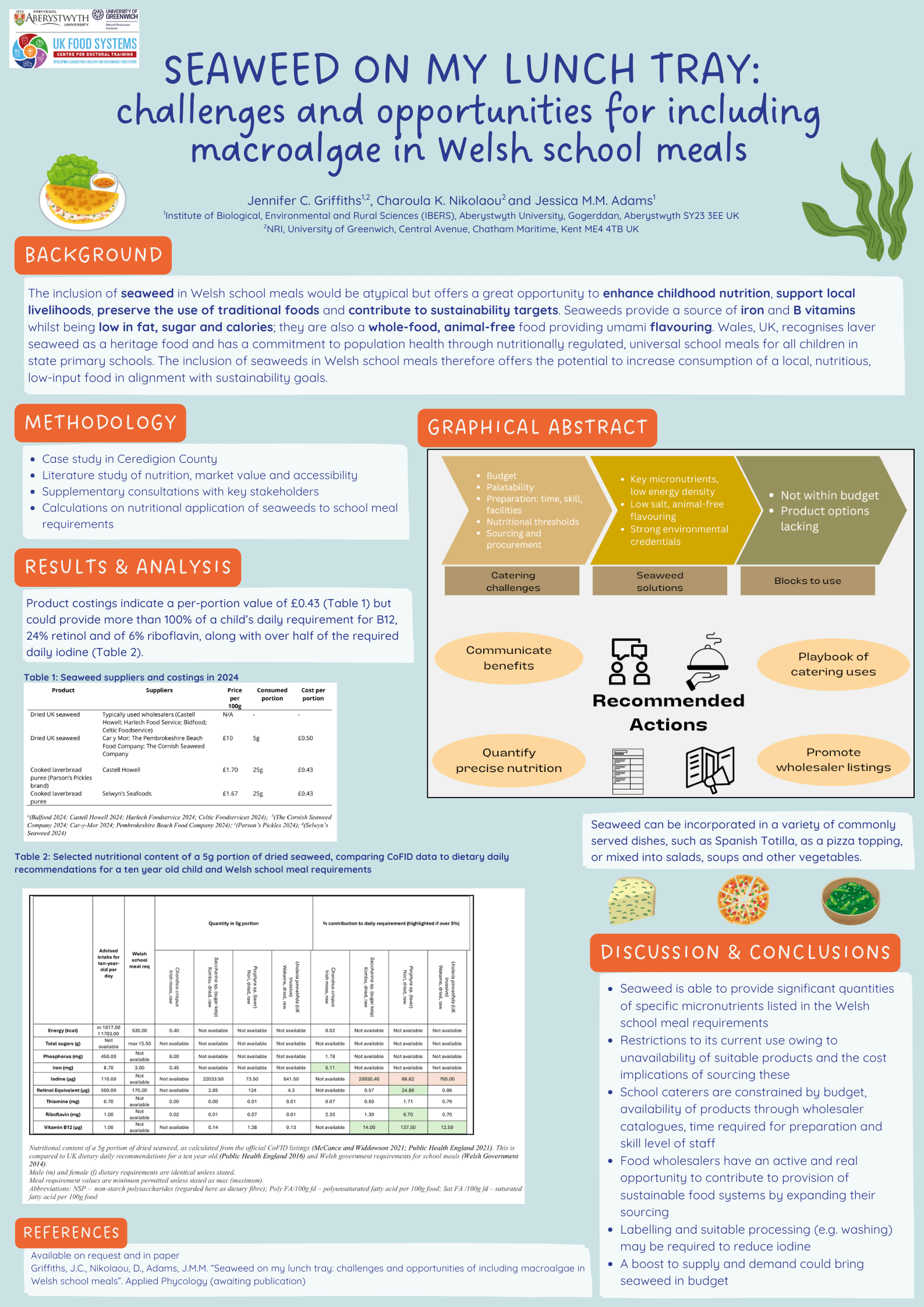
- 4. Jennifer Griffiths: Seaweed on my lunch tray: challenges and opportunities of including macroalgae in Welsh school meals
- 5. Thomas Ball: Food impacts on species extinction risks can vary by three orders of magnitude
- 6. Vandy Butcher, Patricia Doughlin, Lisa Howard: So, you’re thinking about becoming a community researcher? A handbook of insights and learning (including case studies), co-created by 19 community researchers and 2 community coordinators from FoodSEqual
- 7. Rosie Tsikritzi: Co-creating pulse-based snacks: a UK innovation journey
- 8. Behrouz Arabi, Sonal Choudhary: Introducing a comprehensive AI-enabled food data catalogue: leveraging data infrastructure to address the challenge of feeding all people well
- 9. Andrew Westby: Update on UK Food Systems Centre for Doctoral Training
- 10. Jessica Bosseaux, Eugene Mohareb: Towards a comprehensive stakeholders and hotspots categorisation: a Delphi Method contribution to post-productivist social life cycle assessment
- 11. Rob Oxley: Mapping Influences on School Food Consumption Across Deprivation Levels: Relational Content Analysis of Pupil and School Leadership Perspectives
- 12. Owen Nicholas: Estimating global and UK uncertainty in GHG and land use impacts of substituting pulses for poultry for beef, from Poore & Nemecek LCA data
- 13. Marta Lonie: Bridging Theory and practice for actionable change in transforming food systems (BRIDGE-ACT): Impact Planner Toolkit
Films: Watch the TUKFS26 video playlist (opens in YouTube)
- 1. Martin White: Mandala Consortium: The Mandal Consortium – Transforming Urban Food Systems for Public and Planetary Health.
- 2. Belinda Morris: Fix Our Food Yorkshire Stories of Sustainability – Yorkshire Rapeseed Oil
- 3. Jean Adams: Mandala Consortium Stories from a Changing Food System: Change Kitchen
- 4. Belinda Morris: Fix Our Food Yorkshire Grain Alliance – Leeds Bread Co-op
- 5. Emma Frew: Mandala Consortium Stories from a Changing Food System: Pathways to Universal Free School Meals
- 6. Tracey McNeilly: H3 H3: Healthy Soil, Healthy Food, Healthy People
- 7. Alexia Sawyer: Mandala Consortium Stories from a Changing Food System: Evaluating a food hub model to redirect food to communities.
- 8. Lynn Dicks: H3 Deep Seed: Prof Lynn Dicks talks about regenerative farming
- 9. Marta Lonnie: FoodSEqual FIO Food Project
- 10. Kelly Parsons: Mandala Consortium Stories from a Changing Food System: Designing more environmentally sustainable hospital menus.
- 11. Marta Lonnie: FoodSEqual Bridge-Act project
Contact
Socials
- Follow x.com/mandala_food
- Share with #TUKFS26